

Multi-Depot Rental Management: How to Scale Locations Without Equipment “Black Holes”
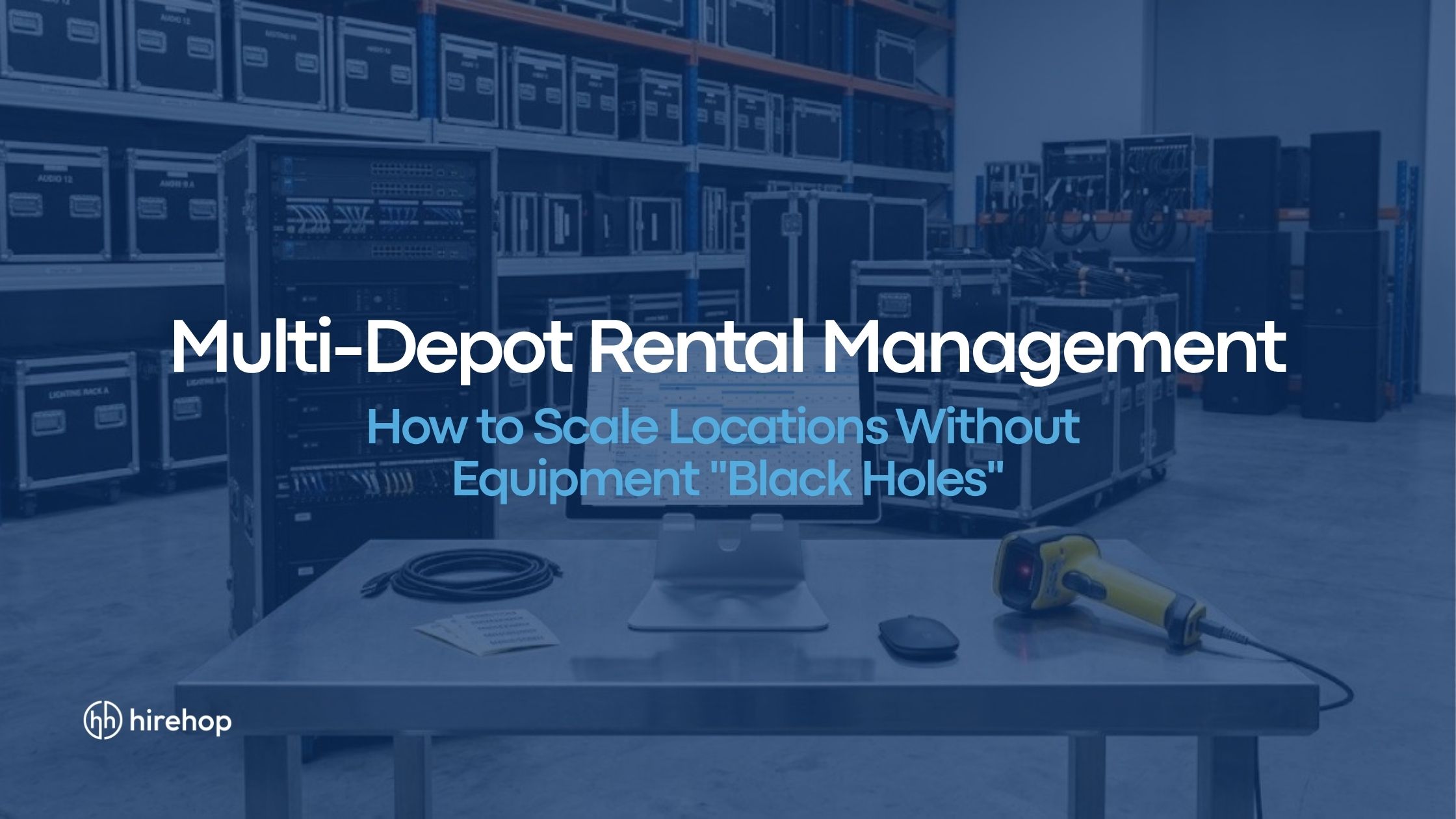
Opening a second or third depot is a massive milestone for any rental business. It means demand is growing, your footprint is expanding and you’re getting closer to your customers.
On paper, expanding your capacity should linearly grow your revenue. In practice, adding a new location doubles your operational complexity overnight.
Suddenly, gear that was scanned out of Depot A gets returned to Depot B. Crew members start “borrowing” high-value kit without logging transfers, inventory levels on your system stop matching physical reality on the warehouse floor, and equipment disappears into what every rental manager fears most: the multi-depot black hole.
If you’re spending more time chasing phantom stock across branches than actually renting kit, your management setup is working against you. Here is how to scale your locations without losing control of your inventory.
In This Guide:
- Eliminate the “Phantom Inventory” Problem
- Stop “Wild West” Equipment Transfers
- Optimise Sub-Renting vs. Internal Hires
- Standardise Asset Tracking Across All Sites
- Centralised Reporting with Local Autonomy
1. Eliminate the “Phantom Inventory” Problem
The quickest way to burn customer trust is accepting a high-value booking at your northern branch, only to discover on prep day that the kit was shipped to your southern warehouse three weeks ago and never logged back.
When depots operate on separate databases or rely on static spreadsheets updated at the end of the day, inventory visibility drops to zero.
The Fix: Centralise your database in real time. Every branch needs line-of-sight into every single asset across the business, right down to its live availability status and current physical GPS or depot location. If Depot B needs four moving heads for a Friday event, they should be able to see — and reserve — unallocated stock sitting in Depot A with a single click.
2. Stop “Wild West” Equipment Transfers
Inter-depot transfers are the #1 cause of lost hire gear. When branch managers treat transfers like informal favours — like loading a van without a formal transfer note or digital handoff — assets inevitably slip through the cracks.
The Fix: Treat inter-depot transfers with the exact same rigour as customer rentals.
➡ Internal Hires: Never move equipment between branches without a generated internal hire.
➡ Dual-Scanning: Depot A scans the asset out on dispatch; Depot B scans it in upon arrival.
➡ Chain of Custody: Until Depot B scans the barcode, QR code or RFID tag onto their floor, the asset remains logged under Depot A’s operational responsibility.
This eliminates the “he said, she said” debate when a £5,000 flight case goes missing mid-transit.
3. Optimise Sub-Renting vs. Internal Hires
When a customer requests a package that exceeds a single depot’s stock, branch managers usually face a dilemma: do we sub-hire from an external competitor, or transfer stock internally from another branch?
Without clear cost visibility, managers often make the wrong call, paying hefty external re-hire rates when kit is sitting idle two towns over, or spending £300 in transport costs to transfer a £50 item across branches.
The Fix: Smart cross-depot availability reporting. Your rental software should automatically flag when internal assets are sitting idle at nearby branches before you commit to an external sub-rental. By factoring in transport logistics alongside sub-hire rates, your team can make the most profitable decision in seconds.
4. Standardise Asset Tracking Across All Sites
If Depot A uses 1D barcodes on dedicated laser scanners, but Depot B relies on manual asset numbers written on masking tape, multi-depot ops will break down fast.
When equipment rotates between locations, scanning protocols must remain seamless.
The Fix: Flexible, unified tracking. Whether your branches are scanning 1D barcodes, QR codes on mobile phones, or bulk-scanning RFID tags at warehouse gates, ensure your rental software natively supports hybrid scanning methods. A flight case dispatched from a barcode-heavy warehouse should be just as easy to scan into an RFID-enabled depot.
5. Centralised Reporting with Local Autonomy
Scaling multi-depot management isn’t about micromanaging every branch manager’s day-to-day decisions. It’s about giving central management bird’s-eye financial clarity while empowering branch teams to move fast.
Key metrics to track across multi-depot operations:
- Depot P&L Transparency: Accurately attribute revenue and maintenance costs to the asset’s home depot, even when rented elsewhere.
- Utilisation Rate per Depot: Is one location carrying dead stock while another constantly sub-rents?
- Transfer Bottlenecks: How long does gear spend in transit between locations?
Scale Without the Headache
Multi-depot expansion doesn’t have to mean endless chasing, missing flight cases or bloated sub-hire costs. With a cloud-based rental management system built for real-time, multi-location tracking, you can scale your footprint while keeping every single asset firmly on your radar.
HireHop was built from the ground up to handle complex, multi-depot hire operations. From real-time inter-depot transfers and automated cross-depot availability to hybrid barcode, QR, NFC and RFID scanning, we help you scale your business without losing track of your kit.
Want to see how HireHop can eliminate your inventory black holes? Book a free demo today.